Container Homes in St. Petersburg FL — Build Your Dream Home
Affordable, Sustainable Housing from Shipping Containers — Tiny Homes, ADUs, and Airbnb Rentals
Why Build a Container Home in St. Petersburg?
St. Petersburg, Florida, is experiencing a housing transformation. With median home prices exceeding $380,000 and rising, residents are looking for creative, affordable alternatives — and shipping container homes are emerging as one of the most practical solutions. Container homes combine industrial strength with architectural flexibility, offering a path to homeownership, rental income, or simply more living space at a fraction of traditional construction costs.
The Tampa Bay area is uniquely well-suited for container home construction. The region's progressive building culture, growing tiny home community, thriving Airbnb market, and year-round mild climate make St. Petersburg one of the best cities in Florida to build a container-based structure.
Cost Savings
Build for $80–$150 per square foot compared to $200–$350+ for traditional new construction in Pinellas County. A 640 sq. ft. container home can be completed for $50,000–$96,000 including the container, foundation, and full buildout.
Speed
Container homes can be built in 8–16 weeks from foundation to move-in, compared to 6–12 months for a traditional home. The container provides the structural shell from day one — no framing phase.
Sustainability
Each repurposed container keeps 3,500 kg of steel out of the waste stream. Container homes require less lumber, less concrete, and produce less construction waste than conventional building.
Florida Building Codes & Permits for Container Homes
Building a container home in Florida is absolutely legal, but it requires navigating the same permitting and code compliance process as any residential construction. Here's what you need to know for Pinellas County and the City of St. Petersburg:
Florida Building Code (FBC) Requirements
Florida adopted the Florida Building Code (FBC), which is based on the International Building Code (IBC) and International Residential Code (IRC) with Florida-specific amendments. Container homes must comply with the same standards as any residential structure:
- Structural: The container structure must meet Florida wind load requirements. In Pinellas County, the design wind speed is 150 mph (Risk Category II per FBC 7th Edition). Shipping containers, originally designed for ocean transport, inherently exceed most structural requirements — but an engineer's stamped plans confirming compliance are required.
- Electrical: Must comply with NEC (National Electrical Code) as adopted by Florida. All electrical work requires a licensed electrician and separate electrical permit.
- Plumbing: Must comply with the Florida Plumbing Code. Connection to municipal water and sewer (or approved septic system) required.
- Energy: Must meet the Florida Energy Conservation Code. In the Tampa Bay area (Climate Zone 2A), this means specific insulation R-values, window U-factors, and HVAC efficiency ratings.
- Accessibility: Single-family homes are generally exempt from ADA requirements, but if you're building a rental (ADU or Airbnb), accessibility provisions may apply.
Pinellas County & St. Petersburg Permitting
- City of St. Petersburg Development Services: (727) 893-7171 — permits, zoning inquiries
- Pinellas County Building Services: (727) 464-3888 — for unincorporated areas
- Pinellas County Property Appraiser: (727) 464-3207 — zoning and land use verification
The permitting process for a container home in St. Petersburg typically involves:
- Zoning verification — Confirm that your lot allows the type of structure you're planning (single-family, ADU, etc.). The City of St. Petersburg has been increasingly friendly to ADUs (Accessory Dwelling Units) in recent years.
- Architectural plans — Stamped drawings from a licensed Florida architect or engineer, showing floor plan, structural details, electrical layout, plumbing, and mechanical systems.
- Building permit application — Submit plans to the local building department for review. Expect 2–6 weeks for plan review in Pinellas County.
- Inspections during construction — Foundation, framing (container placement), electrical rough-in, plumbing rough-in, insulation, and final inspection.
- Certificate of Occupancy (CO) — Issued after final inspection passes. Required before anyone can legally live in the structure.
Pro tip: Many building departments in Florida are still relatively unfamiliar with container construction. We recommend engaging an architect or contractor who has experience with container homes and can communicate effectively with plan reviewers. This avoids unnecessary delays and revision requests.
Best Containers for Home Construction
Not all shipping containers are equally suited for residential conversion. Here's what we recommend for home builders in the Tampa Bay area:
| Container Type | Dimensions (Interior) | Livable Space | Best For | Our Recommendation |
|---|---|---|---|---|
| 20ft Standard | 19'4" x 7'8" x 7'10" | ~148 sq. ft. | Micro studio, office, bathroom addition | Good for additions, not primary living |
| 40ft Standard | 39'5" x 7'8" x 7'10" | ~302 sq. ft. | Studio apartment, ADU, Airbnb unit | Minimum for comfortable living space |
| 40ft High Cube | 39'5" x 7'8" x 8'10" | ~302 sq. ft. | Primary residence, ADU, Airbnb | Top choice — extra 12" ceiling height is critical |
| 2x 40ft HC (Side by Side) | 39'5" x 15'8" x 8'10" | ~620 sq. ft. | 2-bedroom home, family ADU, premium Airbnb | Most popular configuration for homes |
| 1x 40ft HC + 1x 20ft HC | Various configurations | ~460 sq. ft. | 1-bedroom home, L-shaped layout | Creative layouts with distinct zones |
Insulation for Florida's Climate
Insulation is the single most important factor in making a steel container livable in Florida. Without proper insulation, a container in St. Petersburg will reach 140+ degrees Fahrenheit interior temperature during summer and will drip with condensation year-round. With proper insulation, it becomes a comfortable, energy-efficient home.
Insulation Options Compared
| Method | R-Value per Inch | Thickness Needed | Cost (per sq. ft.) | Florida Suitability |
|---|---|---|---|---|
| Closed-Cell Spray Foam | R-6.5 | 2–3 inches | $1.50 – $3.00 | Excellent — our top recommendation |
| Open-Cell Spray Foam | R-3.7 | 3–5 inches | $0.75 – $1.50 | Good — but needs separate vapor barrier |
| Rigid Foam Board (XPS/Polyiso) | R-5 to R-6.5 | 2–3 inches | $0.50 – $1.00 (material only) | Good — budget option, more labor to install |
| Fiberglass Batts | R-3.2 | 3.5+ inches | $0.30 – $0.60 | Not recommended — absorbs moisture, loses R-value |
Our recommendation: Closed-cell spray foam is the gold standard for container homes in Florida. It provides the highest R-value per inch (preserving precious interior space), acts as its own vapor barrier (critical in Florida's humidity), adheres directly to the steel walls (eliminating air gaps), and adds structural rigidity. For a 40ft HC container, expect to spend $3,000–$5,000 for professional spray foam insulation on walls, ceiling, and underfloor.
The Florida Energy Code requires a minimum of R-13 for walls and R-30 for ceilings in Climate Zone 2A (Tampa Bay). With 2 inches of closed-cell spray foam on walls (R-13) and 4–5 inches on the ceiling (R-26 to R-32), you'll meet or exceed code requirements while keeping your interior dimensions as large as possible.
Floor Plan Ideas
Container homes are remarkably versatile in layout despite their narrow profile. Here are the most popular floor plans we see built in the Tampa Bay area:
Single 40ft HC — Studio/1BR (320 sq. ft.)
The simplest and most affordable container home. A single 40ft high cube provides enough space for a full kitchen, living area, bathroom, and either an open sleeping area (studio) or a partitioned bedroom.
- Kitchen and dining at one end
- Bathroom with shower in the middle
- Living/sleeping area at the other end
- Ideal for: ADU, Airbnb studio, single occupant
Two 40ft HC Side-by-Side — 2BR Home (640 sq. ft.)
The most popular configuration. Two 40ft high cubes placed side by side with sections of the interior walls removed to create an open floor plan. Structural reinforcement (steel beams) maintains integrity where walls are cut.
- Open kitchen/living room spanning both containers
- Master bedroom with ensuite in one container
- Second bedroom/office in the other container
- Ideal for: Couples, small families, premium Airbnb
L-Shaped (40ft + 20ft) — 1BR with Patio (460 sq. ft.)
A 40ft container as the main living space with a 20ft container perpendicular to it, creating a natural L-shape that defines an outdoor living area — perfect for Florida's indoor-outdoor lifestyle.
- 40ft container: living room, kitchen, bathroom
- 20ft container: bedroom/guest suite
- L-shaped courtyard for covered patio/deck
- Ideal for: Florida lifestyle, entertaining, unique design
Stacked (40ft over 40ft) — 2-Story Home (640 sq. ft.)
Two 40ft containers stacked vertically with an interior staircase. Maximizes living space on a small lot footprint — particularly valuable in St. Petersburg where land costs are high.
- Ground floor: kitchen, living room, bathroom
- Upper floor: bedroom, office, second bath
- Rooftop deck potential (with railing)
- Ideal for: Small lots, urban infill, maximizing space
Cost Breakdown: Container Home Construction
One of the biggest advantages of container homes is cost transparency. Here's a realistic budget breakdown for a two-container (640 sq. ft.) home in the St. Petersburg area, based on 2024–2025 pricing:
| Category | Cost Range | Notes |
|---|---|---|
| Containers (2x 40ft HC, One-Trip) | $10,400 – $13,600 | One-trip recommended for homes — cleanest starting point |
| Delivery & Placement | $1,000 – $2,000 | Crane placement for stacked; tilt-bed for side-by-side |
| Foundation | $3,000 – $8,000 | Pier foundation typical; slab for side-by-side |
| Structural Modifications | $5,000 – $12,000 | Wall removal, window/door cutouts, reinforcement beams |
| Insulation (Closed-Cell Spray Foam) | $6,000 – $10,000 | Walls, ceiling, and underfloor — both containers |
| Electrical | $5,000 – $10,000 | Panel, wiring, outlets, lighting, GFCI, permit |
| Plumbing | $4,000 – $8,000 | Kitchen, bathroom(s), water heater, sewer connection |
| HVAC | $3,000 – $6,000 | Mini-split system — ideal for container homes |
| Interior Finish | $8,000 – $18,000 | Drywall/paneling, flooring, kitchen, bathroom tile, paint |
| Windows & Exterior Doors | $3,000 – $8,000 | Impact-rated required in Pinellas County (wind zone) |
| Exterior Finish & Roofing | $2,000 – $6,000 | Paint, cladding (optional), roof overhang for rain protection |
| Permits & Engineering | $3,000 – $6,000 | Architectural plans, engineer stamp, building permits |
| TOTAL (2-Container Home) | $53,400 – $107,600 | $83 – $168 per sq. ft. |
Compare this to traditional new construction in Pinellas County at $200–$350 per square foot, and the savings become clear. Even at the high end of container home construction, you're spending roughly half what a conventional build would cost.
Financing Your Container Home
Financing a container home is different from a conventional home mortgage, but there are several viable options available to buyers in the Tampa Bay area:
Construction Loan
Available through local credit unions and community banks in the Tampa Bay area. Construction loans cover the building process and convert to a permanent mortgage upon completion. You'll need approved plans, a licensed contractor, and the property/land as collateral.
Typical terms: 12–18 month construction phase, then 15–30 year mortgage. Rates vary — shop local lenders who understand alternative construction.
Personal Loan
For smaller container home projects (under $50,000), a personal loan can be the simplest financing option. No collateral required (unsecured), faster approval, and fewer restrictions on how you build.
Typical terms: 3–7 year terms, $10,000–$100,000, higher interest rates than secured loans (8–15% depending on credit).
Home Equity Loan/HELOC
If you already own property in St. Petersburg, a home equity loan or line of credit (HELOC) is an excellent way to finance a container ADU or addition. Lower interest rates than personal loans because your existing property serves as collateral.
Typical terms: 5–30 year terms, rates starting at 6–9%, tax-deductible interest in some cases.
Cash / Self-Funded
Many container home builders pay cash in stages — buying the container first, then funding each construction phase as they go. This eliminates interest costs entirely and gives you maximum flexibility on timeline and contractor choices.
Advantage: No lender requirements for plans or inspections beyond what's required by the building department. Full control.
Airbnb & Rental Income Potential
St. Petersburg's booming tourism market makes container homes an exceptional investment for short-term rental income. The city's arts district, waterfront, craft breweries, and year-round events draw over 15 million visitors annually to the Tampa Bay area — and unique accommodations like container homes command premium rates on Airbnb and VRBO.
Estimated Airbnb Revenue (St. Petersburg)
- Container studio (320 sq. ft.): $100–$175/night, 65–75% occupancy = $24,000–$48,000/year
- Container 1BR (460 sq. ft.): $130–$200/night, 65–75% occupancy = $31,000–$55,000/year
- Container 2BR (640 sq. ft.): $175–$275/night, 65–75% occupancy = $42,000–$75,000/year
Revenue estimates based on comparable unique properties in the St. Petersburg/Tampa Bay area. Actual results depend on location, design, amenities, and marketing.
Why Container Homes Book Well
- Unique factor — "Container home" listings generate curiosity and higher click-through rates
- Instagram appeal — Modern industrial design photographs beautifully for social media
- Eco-conscious travelers — Growing segment of guests actively seeking sustainable accommodations
- Premium pricing — Unique properties in St. Petersburg command 20–40% premiums over comparable standard rentals
- Press coverage — Container homes frequently get featured in local media, travel blogs, and design publications
Gallery of Container Home Project Types
Container homes are incredibly versatile. Here are the types of projects our customers in the Tampa Bay area are building:
Backyard ADU
A single 40ft high cube converted into a guest house, in-law suite, or rental unit in the backyard of an existing home. St. Petersburg's growing support for ADUs makes this an increasingly popular option for homeowners looking to add value and income to their property.
Tiny Home
A fully self-contained 320 sq. ft. home built from a single container. Perfect for minimalist living, starter homes, or downsizing retirees. Florida's tiny home movement is growing rapidly, and St. Petersburg is at the center of it.
Primary Residence
Multi-container homes (2–4 containers) configured into full family residences with 2–3 bedrooms, multiple bathrooms, and open living areas. These homes can be indistinguishable from conventional construction when properly finished.
Home Office/Studio
A 20ft container converted into a dedicated home office, art studio, or workshop. The most affordable container building project — many are completed for under $15,000 including the container, insulation, electrical, and AC.
Pool House/Cabana
A container positioned near the pool as a changing room, outdoor kitchen, and entertaining space. The industrial aesthetic pairs perfectly with modern pool designs popular in St. Petersburg's newer developments.
Airbnb Investment
Purpose-built container rental units designed to maximize booking rates and revenue. Clean modern design, efficient layout, and the "unique stay" factor that drives premium pricing on short-term rental platforms.
Frequently Asked Questions
Are container homes legal in St. Petersburg, Florida?
Yes. Container homes are legal in Florida when they comply with the Florida Building Code and local zoning requirements. You'll need stamped architectural/engineering plans, a building permit, and inspections — the same process as any residential construction. The City of St. Petersburg does not have any specific prohibition against container construction. The key requirement is that the finished home meets all code standards for habitable structures.
How long does it take to build a container home in Tampa Bay?
A typical container home project in the Tampa Bay area takes 3–6 months from permit application to certificate of occupancy. The breakdown: 2–6 weeks for permit approval, 1–2 weeks for foundation, 1 week for container delivery and placement, and 6–12 weeks for buildout (insulation, electrical, plumbing, HVAC, interior finish). Simple single-container projects can be completed faster; complex multi-container homes may take longer.
Can a container home withstand a Florida hurricane?
Yes — and in many cases, better than conventional wood-frame construction. Shipping containers are built from 14-gauge Corten steel and are engineered to be stacked 9-high when fully loaded. The structural integrity of a container far exceeds the wind load requirements in Pinellas County (150 mph design wind speed). The container must be properly anchored to its foundation, and windows/doors must be impact-rated, but the container shell itself is exceptionally hurricane-resistant.
Do container homes rust in Florida's humid climate?
Shipping containers are made from Corten steel, which is specifically formulated to resist atmospheric corrosion by developing a protective rust patina. In Florida's climate, surface oxidation is normal and actually protects the steel underneath. With proper treatment (exterior paint or cladding), a container home will not experience structural rust issues. Many owners apply marine-grade paint, vinyl siding, or wood cladding for both aesthetics and additional protection. Interior condensation is managed through proper insulation — closed-cell spray foam creates a vapor barrier that prevents moisture from reaching the steel.
What containers do you recommend for a home project?
We strongly recommend 40ft High Cube (HC) One-Trip containers for home construction. One-trip containers have made a single ocean voyage, so the steel is in excellent condition with no structural repairs, minimal surface wear, and a clean interior free of chemical residues. The High Cube height (9'6" exterior) is essential — it provides enough ceiling height after insulation and flooring to meet code requirements and feel comfortable. For a typical 2-bedroom home, you'll need two 40ft HC containers. Contact us to reserve your containers and we'll hold them until your permits are approved.
Available Containers
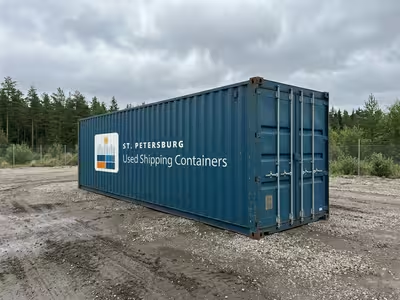 Customer Favorite
40ft High Cube Cargo Worthy Container
From $2,450
The most popular choice for residential conversions in the Tampa Bay area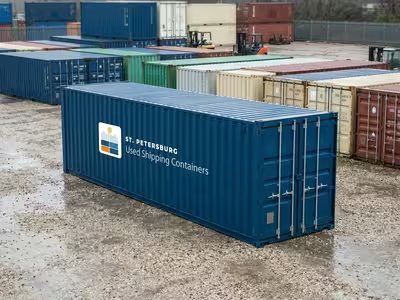 Top Conversion Choice
40ft High Cube One-Trip Container
From $3,800
The flagship residential build platform — full size, full height, near-new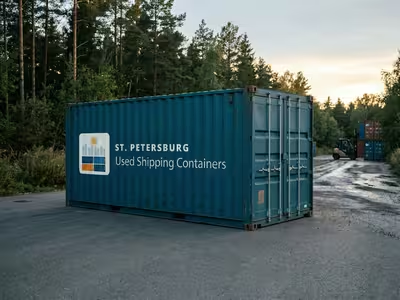
20ft High Cube Cargo Worthy Container
From $1,750
Small footprint, taller walls, certified structure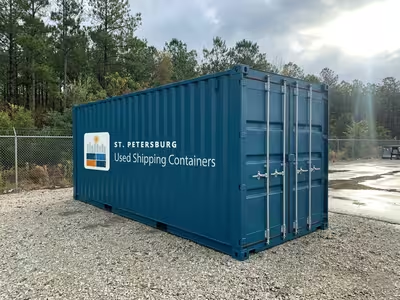
20ft High Cube One-Trip Container
From $3,100
Taller profile, near-new conditionReady to Start Your Container Home Project?
We supply the containers — tell us your vision and we'll help you find the right units.